
Late-season hedge trimming runs on the plant’s calendar, not the yard’s. The cedars have crept over the front walk all summer, the yard is finally getting tidied, and it feels like the moment to cut everything back hard before winter. Fair instinct. It’s also the one time of year when a heavy trim can damage a hedge that was perfectly healthy in August.
Late-season hedge trimming isn’t off the table in Kitchener-Waterloo. It just has rules. Here’s when to cut, when to stop, and what shouldn’t be touched until spring.
Stop shaping about six weeks before hard frost
A shrub answers a cut by pushing new growth. That’s the whole point of trimming in June. The problem in October is that the new growth arrives soft, green and full of water, and it needs roughly six weeks of decent weather to harden off before it can survive a freeze.
Our first hard frost in Waterloo Region usually lands somewhere in October, and the date moves every year. Work backwards and the shaping window closes in early September. Cut a hedge hard in mid October and you’re asking it to push tender growth in the exact fortnight it gets frozen. Come spring you find browned tips along the whole cut line and a hedge that looks worse than if you’d left it alone.
That’s why our tree and hedge trimming page puts the real shaping window at late June through August, with a lighter tidy in early fall. Autumn work stays deliberately light. That’s the plant’s calendar, not ours.
Once it’s properly dormant, the rules change
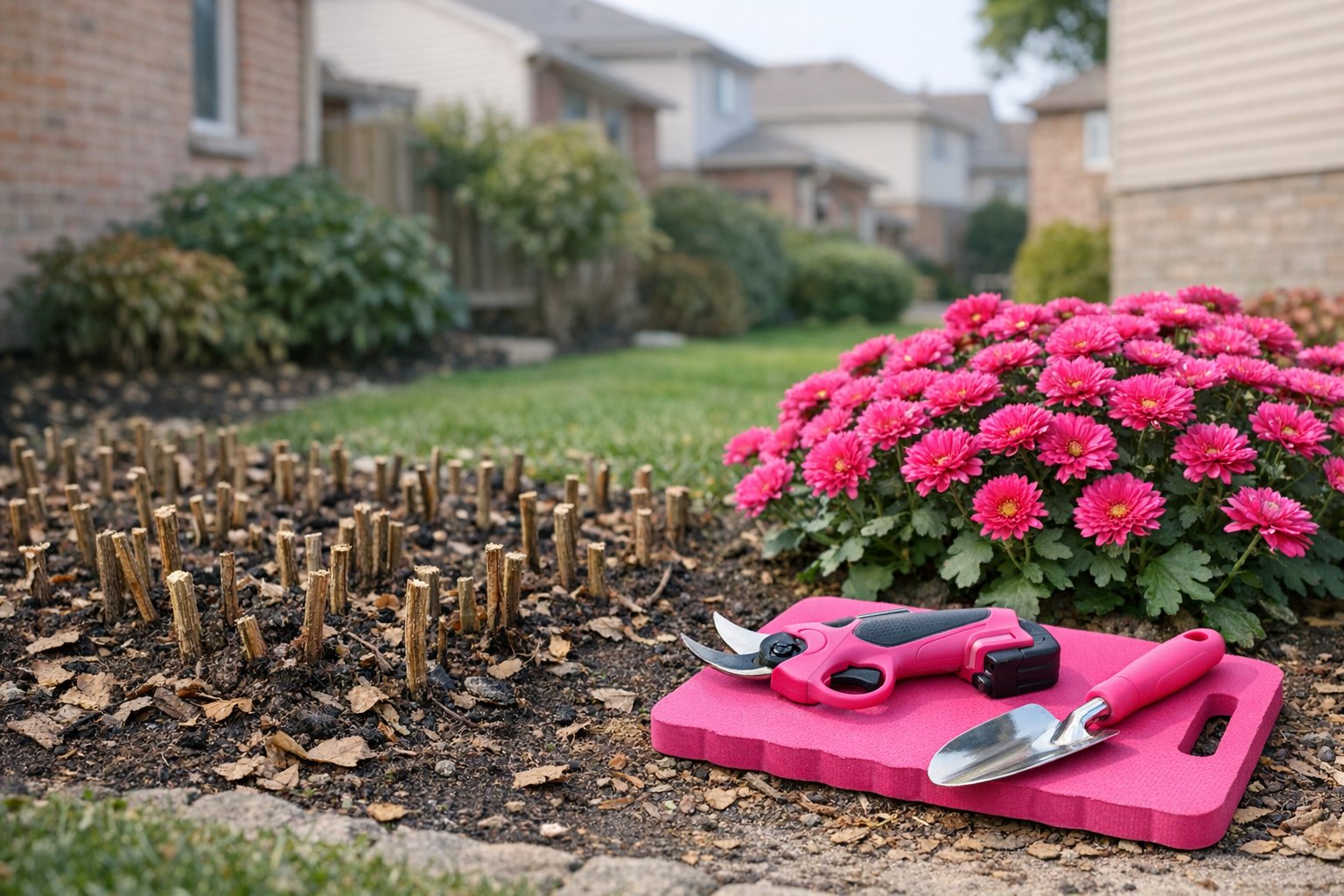
There’s a second window, and it isn’t fall. It’s late winter, once the shrub is fully dormant and the worst cold is behind us, usually late February into March here. A dormant plant isn’t trying to grow, so a cut triggers nothing tender. Structural work on deciduous shrubs, thinning, old canes out, an overgrown hedge brought back in stages, all of that belongs there rather than in November.
So the honest answer to “cut it back hard before winter” is almost always no. The fall job is a tidy.
What not to cut in fall
Anything that flowers in spring. Lilac, forsythia, magnolia, rhododendron and weigela set next spring’s flower buds during the summer. Those buds are on the branch right now. Shear the plant in October and you’re cutting off the flowers, then wondering in May why the lilac did nothing. Spring bloomers get pruned right after they finish flowering.
Bigleaf and oakleaf hydrangeas. Same story. They bloom on old wood, so the stems standing there now are next summer’s flowers. Panicle and smooth types such as Limelight and Annabelle bloom on new wood and can be cut, but even those are better handled in late winter.
Cedars, past the green. A cedar won’t regrow from bare brown wood. Cut into the woody interior and you’re left with a permanent hole in the hedge. Late-season work on cedars means green tips only, which is why an overgrown cedar run has to be brought back gradually over two or three seasons.
Boxwood, hard. Boxwood pushes soft growth fast after a cut, and that growth burns in a KW winter, especially on the windward side. A light tidy is fine. A reshaping is a June job.
Anything with a nest in it. If there’s an active bird nest in the hedge, we leave that section and come back. Nests are protected in Canada, and it’s the right call anyway.
What’s fine to cut in any month
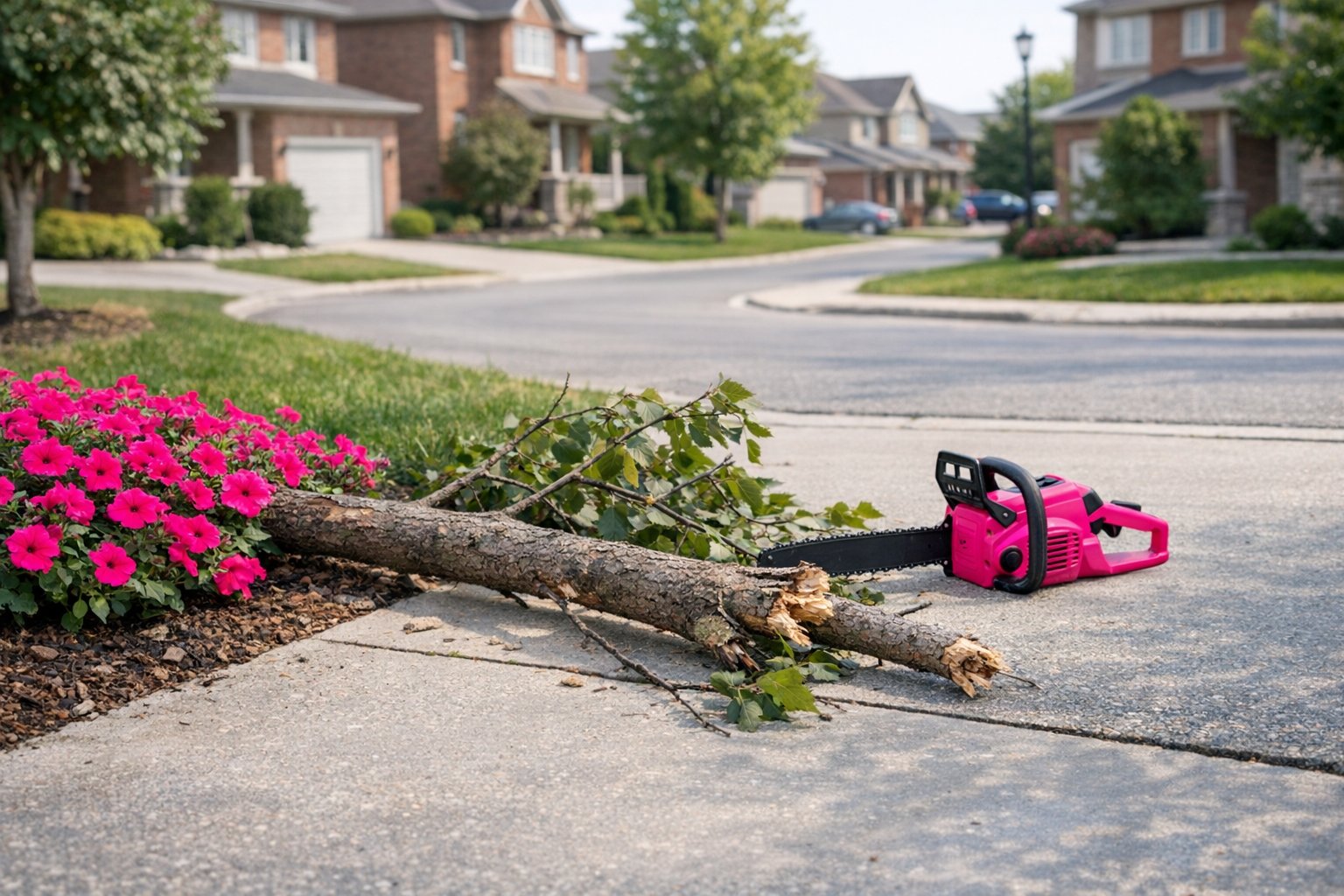
Dead, broken, cracked or hanging wood comes off whenever you spot it. A cracked limb over a driveway doesn’t get safer by waiting until April, and the first heavy wet snow is exactly what brings it down.
Clearance cuts are fair game too. Growth leaning over the front walk, branches at head height across the city sidewalk, limbs rubbing the eavestrough. That’s not shaping, it’s taking off what’s in the way, and the plant barely notices.
There’s a winter reason to do it now. If you have snow clearing booked, our crew comes out after every snowfall of 5 cm or more, usually within 12 hours of the snow stopping, and often in the dark. A cedar branch that’s a minor nuisance in September is a real obstruction at 5 am in January.
| Job | Fall, before dormancy | Late winter, fully dormant |
|---|---|---|
| Dead and broken branches | Yes, always | Yes |
| Clearance off walks, drive, roof | Yes | Yes |
| Light tidy on cedars, green tips only | Yes | Better in summer |
| Hard reshaping of a hedge | No | Yes, in stages |
| Spring bloomers, lilac and forsythia | No, buds are already set | No, prune after they flower |
| Bigleaf hydrangea | No | No, blooms on old wood |
| Boxwood, hard cut | No, winter burn | Wait for June |
One more job before the snow
Upright cedars splay open under snow and ice load. Once the outer stems take that set, they often don’t come back. Tying a multi-stem upright loosely with soft twine before the first real snow keeps it closed. Ask for it while we’re on the property and we’ll add it to the trimming time.
What happens to the clippings
Hedge trimming is billed by the hour, so the tidy-up runs on the same clock. Clippings raked out of the bed, blown off the lawn, the walk and the driveway. We can load the clippings and take them away on the truck. Tell us when you book and it goes in the quote. If you’d rather keep them for your own compost pile, say so and we’ll stack them where you want them.
If the trimming is part of a bigger fall tidy, a yard clean-up starting at $450 plus HST covers trimming, weeding, debris and hauling in one price, with a full day of work at $1,500 plus dump fees for a bigger property. If the shed pile and old fence boards are going too, junk removal starts at $450 plus HST too, with a full day at $1,500 plus dump fees, and item fees like appliances and mattresses priced separately. Fresh mulch from $149 per yard installed plus HST, plus a $110 delivery charge per order, finishes the beds off. Half-yard minimum order, $419 minimum job with delivery included.
What a late-season trim costs
Hedge trimming is a quoted add-on, not something you buy online: $125 per hour plus HST, with a $75 minimum, so one short hedge is still worth booking. Tree trimming is $95 to $150 per job plus HST for small trees and $150 to $300 plus HST for medium ones. Anything larger is quoted on site, and the assessment visit is free.
Every price is on the pricing page, the rest of what we sell is on the shop, and the detail for this job is on tree and hedge trimming.
Questions people ask about a late-season trim
Is it too late to trim my cedars this year? For a light tidy of green tips and anything hanging over the walk, no. For a real reshaping, yes, and we’ll say so rather than take the booking. Summer is when that job gets done properly.
Can you cut it all back hard so I don’t think about it until spring? Not on cedars or boxwood, and not this time of year. Cutting an overgrown cedar into bare wood leaves a hole that never fills. We bring those back in stages across seasons instead.
My lilac is enormous. Can it wait until after the snow? It can, but the better answer is next June, straight after it flowers. Cutting it now or in late winter removes the buds it’s already set, so you get a tidy lilac with no flowers.
Do you take the trimmings away? We can load the clippings and take them away on the truck. Tell us when you book and it goes in the quote.
Which areas do you cover? Kitchener and Waterloo, plus the Mannheim edge. Not Cambridge. Boundaries are on our service area page, and there are local pages for tree and hedge trimming in Kitchener and in Waterloo.
Get it looked at before the snow
Call or text 226-336-2077 with a photo of the hedge and we’ll tell you honestly whether it’s a job for this month or one for next summer. You can also send it through the quote form, and more answers are on our FAQ.
Our lawn care is chemical-free, and the truck really is pink. Pink is the new green.