
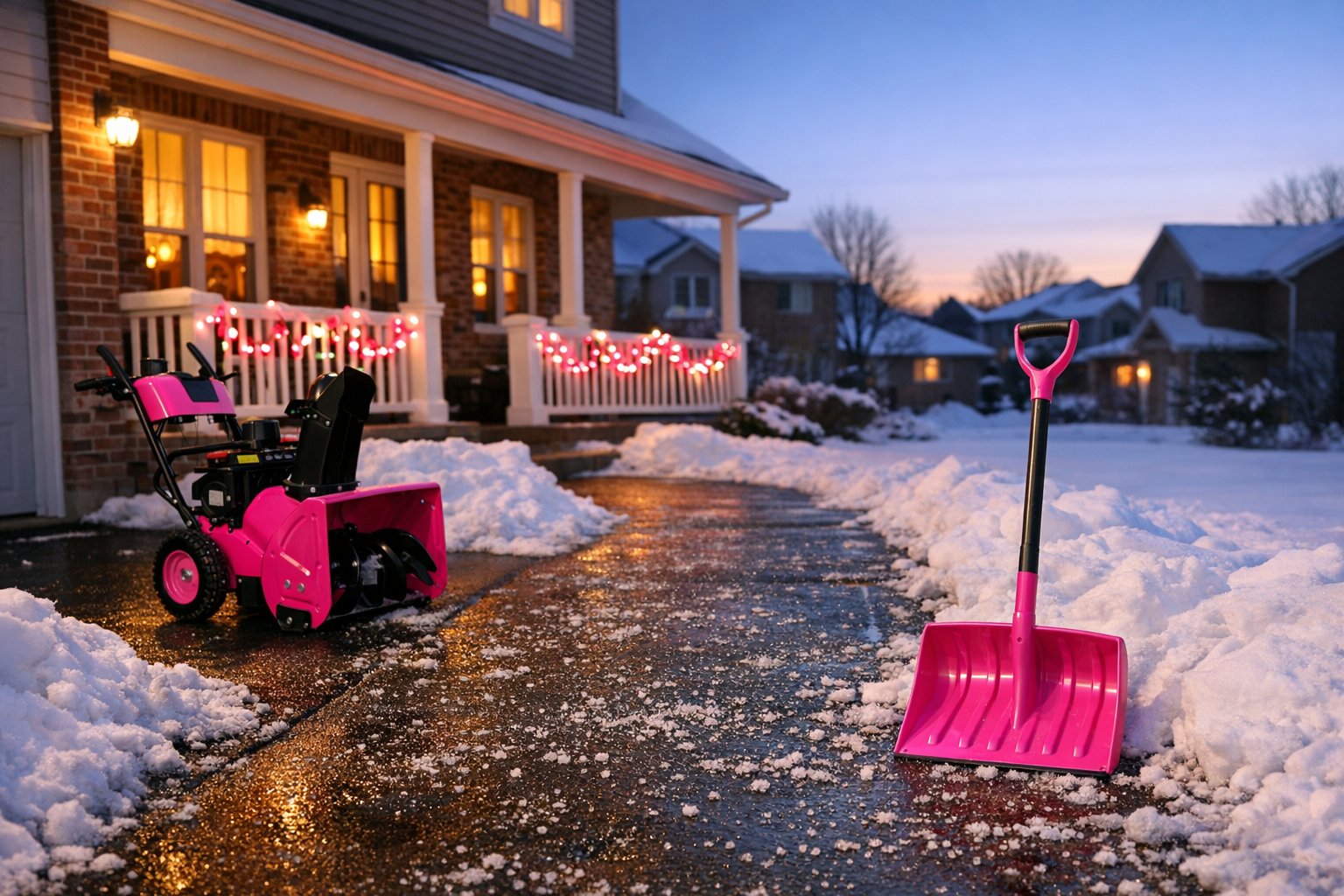
Most of a Kitchener-Waterloo winter, your driveway only has to work for you. You know where it pitches, and you know the patch near the garage that stays slick after every thaw. Holiday driveway safety is the other job it has, and it only matters on the handful of days you have company. Those are the days when the snow clearing has to fit somebody else’s arrival time, and the walk to your door has to be safe for people who’ve never used it.
Then the holidays arrive, and eight people you love walk up that same driveway in the dark, carrying dishes, in shoes chosen for a dinner table rather than a Kitchener winter. Same concrete, completely different job.
Here’s the plain version: why salting is a day-before task, and how to stop a snowfall the night before from deciding your morning.
The guest you’re actually planning for
Every driveway has a hardest user. On a normal Tuesday that’s you. On the 25th it’s whoever is oldest.
A fall on ice is a different event at 78 than it is at 38, and the trip to the hospital lands on the night everyone was meant to be eating. Winter falls also happen where you’d guess: the last two metres to the door, the lip of the step, and the strip beside the car where somebody stands to unload.
So the question isn’t whether the driveway is clear. It’s whether the least sure-footed person coming can get from a car door to your front door without once thinking about their feet. That standard changes three things.
Light matters as much as salt. Black ice is hardest to see in the dark, so turn the porch light on before dusk rather than after.
The walking line counts, not just the driveway. Guests follow the line from where the car stops to the door, and it usually crosses the shaded edge that saw no sun all day.
Handholds beat heroics. Brush the snow off the railing so it can be gripped, and be fussy about salt on the step.
Salting cadence: the day before, not the hour before
This is the part most people have backwards. Salt doesn’t melt ice by being warm. It makes a brine that eats the bond between ice and concrete, and that needs moisture and time. Thrown down five minutes before headlights swing in, it mostly sits there looking busy.
The cadence that actually works across a holiday week:
- Two days out, walk it in daylight. Find the spots that hold ice: the shaded side, the bottom of the slope, the dip that puddles in a thaw. They’ll be where they were last winter.
- The day before, treat those spots. Give it a night to work, then treat again if more weather passes through.
- Salt after a thaw, not only after snow. A mild afternoon that melts, runs to the low spot and freezes again can leave a driveway slicker than a snowfall day.
- Less, more often, beats one big load. More salt isn’t more melting. It’s just more salt, sitting on your lawn edge in April and washing into the drains that feed the Grand River.
Match the product to the night as well. Standard rock salt is included on every driveway we clear and handles an ordinary KW day, but it slows badly in a hard freeze. That’s when the Treated Salt Upgrade earns its keep, and if the family is bringing a dog there’s a Pet-Safe Salt Upgrade as well. Buying per visit, each of those is $10 plus HST a visit. On a Winter plan, Complete and Priority already include your choice of salt at no extra charge.
How you buy clearing matters too. On our Winter plans, ice control with your salt choice runs all season as part of the tier, so freezing rain two days before a family dinner isn’t a decision about whether a call-out is worth it.
When snow lands the night before
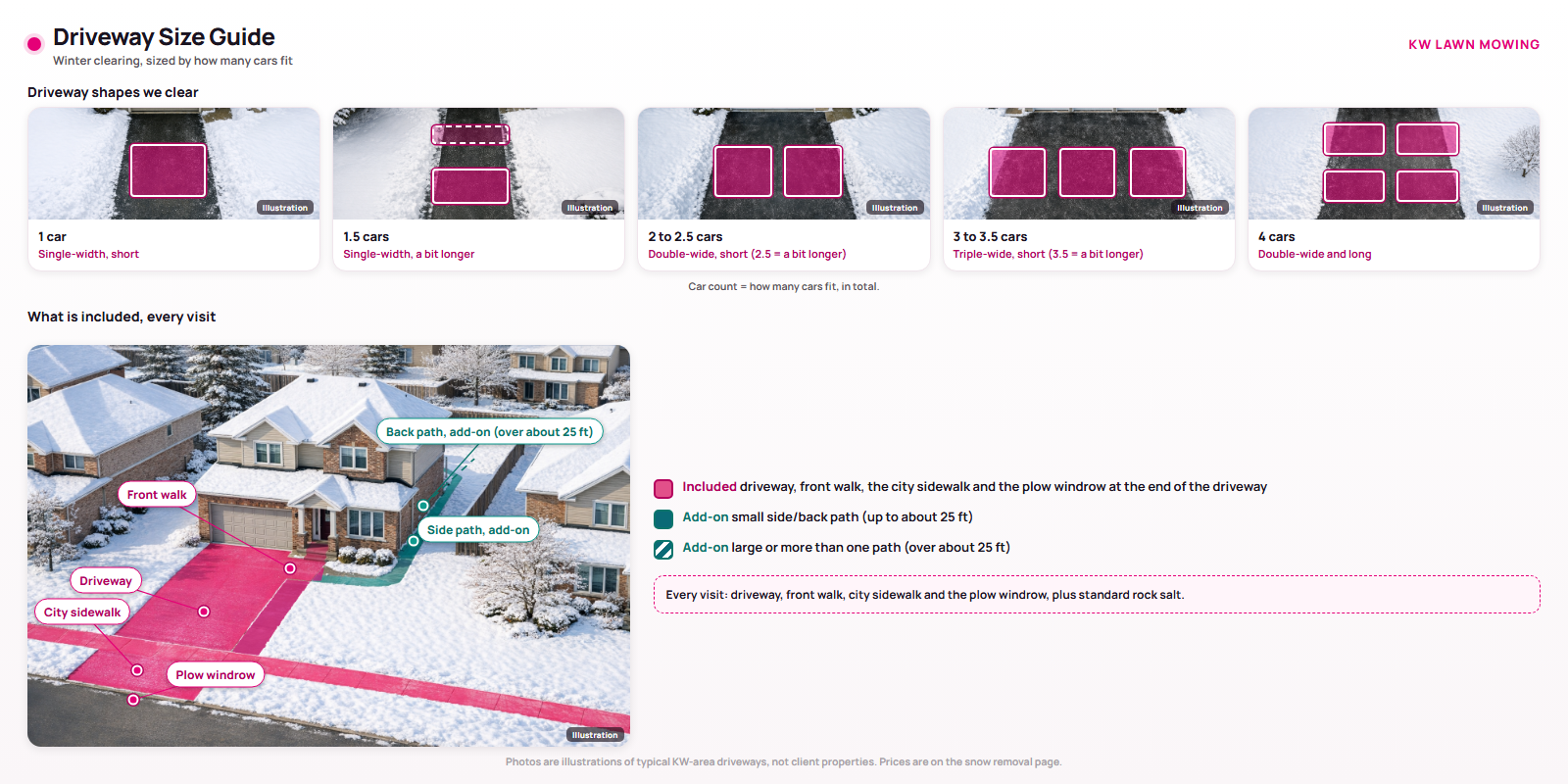
Our trigger is 5 cm. When a snowfall leaves that much or more on the ground, your driveway is cleared automatically, usually within 12 hours of the snow stopping. You don’t call and you don’t need to be home. Every visit covers the driveway, the front path to the door, and the city sidewalk across your frontage.
Twelve hours is the right promise for a normal day. It’s the wrong promise when your sister arrives at eleven and the snow stopped at six.
That’s what the add-on and the plan tiers are for, and a holiday is their single best use:
- Faster Clearing, within 8 hours: $15 plus HST per visit, buyable any time you need it on a per-visit driveway.
- First on the route, usually within 3 hours. This one isn’t a per-visit add-on anymore. It comes bundled into the Winter Priority plan, our top season tier, for anyone who wants to be first on the route every storm rather than just for one holiday week.
If your family only descends once a year, Faster Clearing on the visits that matter is usually the simpler buy: put it on the date people travel and you’re done within 8 hours instead of somewhere inside a 12-hour window. If you host every year and hate leaving it to chance, the Priority plan means you never have to think about it again.
If guests park at the side or come in a back door, add path clearing so the route they use is open: $5 plus HST per visit for a small side or back path up to roughly 25 feet, $10 plus HST per visit for a longer one or several paths.
Every price in this section is a per-visit add-on unless noted as part of a Winter plan tier.
What it costs
Per-visit clearing runs from $49.99 plus HST for a one car driveway up to $99.99 plus HST for a four car, with every size in between on the pricing page, and up to $219.99 plus HST for a ten car.
The season option, Winter Plan Standard, is one price for the whole winter, November 1 to April 15, with unlimited clearings at the 5 cm trigger plus unlimited ice control after freezing rain or light snow. It runs from $712.36 plus HST for a one car driveway up to $1,424.86 plus HST for a four car; bigger driveways still get a whole-season price on a Winter plan, one payment for the whole winter.
For a house that hosts, a Winter Plan is usually the easier answer. Holiday weeks are exactly when you stop wanting to decide about every centimetre.
The day before company
- Walk the driveway in daylight and mark the shaded, sloped and puddling spots
- Treat those spots a full day ahead, then again after any new weather
- Clear the snow off the railing so it can be held
- Turn the porch light on before dusk, not after
- Move your own cars so guests aren’t parking on the strip nobody cleared
- If snow is in the forecast, add Faster Clearing to that date, or sign up for a Winter Priority plan if you host every year
Questions people ask about holiday weeks
Can I add faster clearing for just a few days? Yes. On per-visit pricing it’s a $15 plus HST per visit add-on, not a season commitment. Add it to the visit that matters and that clearing comes within 8 hours instead of the usual 12.
Can I buy being first on the route for just the holidays? Not on its own anymore. First-on-the-route is part of the Winter Priority plan, a season tier, not a single-visit purchase. If you only need speed for one week, Faster Clearing is the per-visit option.
Nothing has fallen, but everything is glazed over. Will you come and salt? On a Winter Plan, yes, unlimited ice control covers freezing rain and light snow that turns slick. If you’re per-visit without a plan, call us and we’ll price salting for your driveway rather than guess at a number here.
How much notice do you need before the holidays? Sooner is better, especially if you want a Winter Priority plan in place before the season fills in.
Do you clear the city sidewalk as well? Yes, every visit. Driveway edge to edge, the front path to your door, the sidewalk across your frontage, and standard rock salt on the driveway. Nobody gets charged extra for the sidewalk.
Get it sorted before the calendar fills
Send us your address and driveway size and we’ll put a fixed price back in writing. Most driveways need no site visit, and assessments are free. Call or text 226-336-2077, or use the quote form.
More on how we clear is on snow removal and the tiered Winter plans page, with neighbourhood detail for Kitchener and Waterloo. We work Kitchener and Waterloo, with Mannheim at the edge, and we don’t go out to Cambridge. Boundaries are on service area, the small print is on policies, and more answers are on the FAQ.
Chemical-free on the lawn all summer, sensible on the driveway all winter. Pink is the new green.