
There’s a decent chance a new young tree has gone in near your street this year. Waterloo is in the middle of a big planting push.
The City of Waterloo received a $1.9 million grant, matched to $3.8 million in total, through the Federation of Canadian Municipalities’ Growing Canada’s Community Canopies program, to purchase and plant 10,000 trees. CBC News and CTV News Kitchener both covered it. The city says the trees go into 82 identified locations across Waterloo, using more than 50 species, with the planting spread over three years, and the goal is partly to diversify the canopy and reduce mowed grass the city has to maintain.
Boulevard and street trees are planted under the city’s own forestry work rather than that grant. Either way, the tree that ends up nearest your lawn has the same problem, and it’s the one in your garage.
That’s good news for a region that has lost canopy to storm damage and ash removals. It’s also a small maintenance problem that lands on the nearest homeowner, which is usually you.
The tree’s real enemy is the equipment
Forget drought, forget bugs. One of the most common ways a young boulevard tree dies is a lawn mower deck or a string trimmer.
Here’s why. The layer that moves water and sugar up and down a tree sits just under the bark. It’s thin, it’s soft on a young trunk, and a string trimmer goes through it in one pass. That pass looks like nothing. A summer of weekly passes leaves a ring of scar tissue around the base, and a tree that’s been ringed all the way around is finished, even though it can take years to show.
Arborists call it girdling. In the trade it’s also called trimmer blight. Either way, the homeowner usually has no idea it happened, because the tree dies slowly and the damage is down at ankle height behind the grass.
Four things that actually protect a young tree
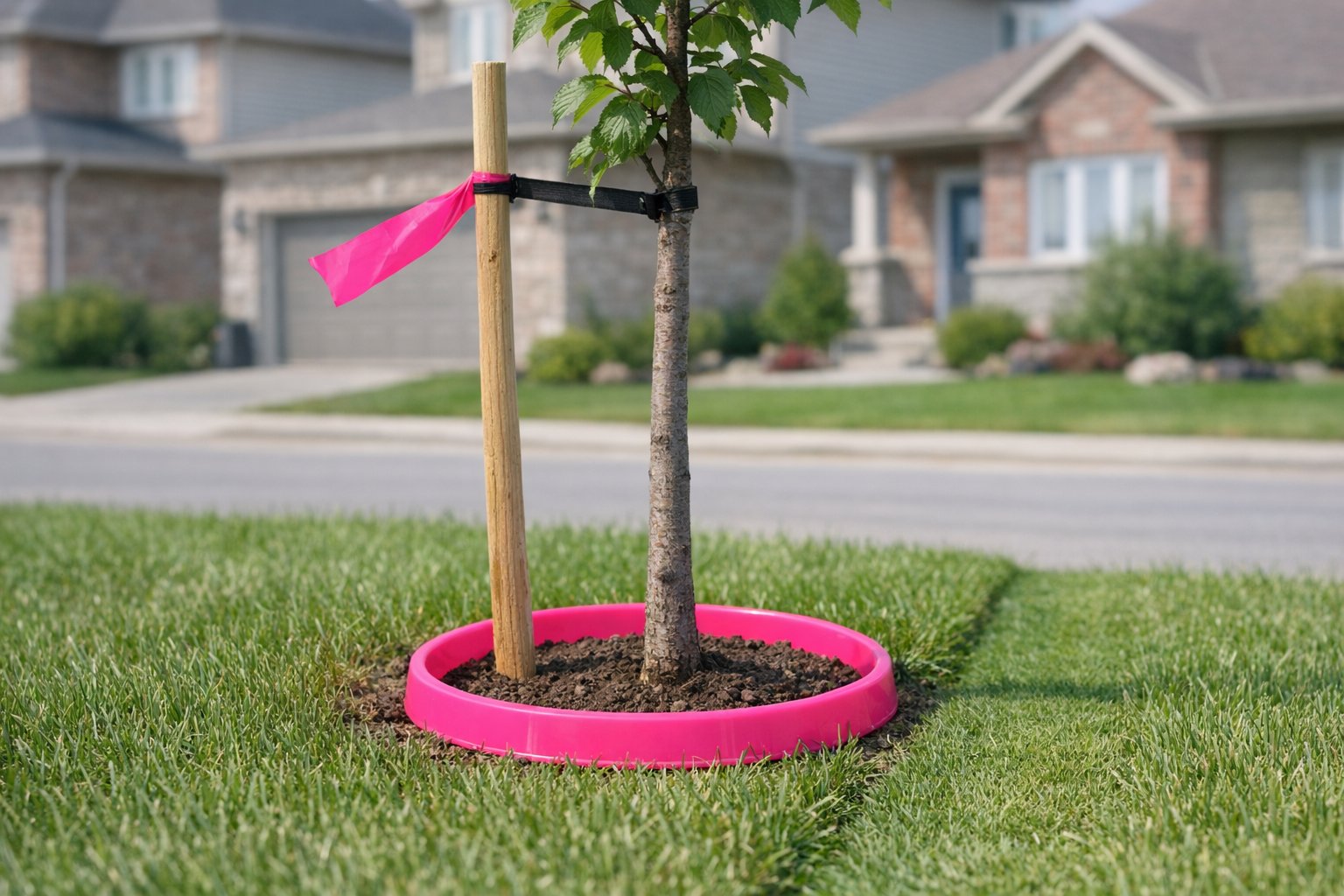
- Keep grass away from the trunk. Not by trimming it closer, by removing it. A grass-free circle roughly a metre across means the trimmer never needs to go near the bark in the first place.
- Mulch that circle, but don’t build a volcano. Two to three inches deep, pulled back a few inches so it never touches the trunk itself. Mulch piled up against bark holds moisture against it, and that rots the very tissue you’re protecting.
- Water deeply, not often. A newly planted tree wants a long slow soak that reaches the root ball, roughly weekly through its first couple of growing seasons in dry stretches. A quick spray from a hose does nothing but wet the mulch.
- Leave the stakes alone, but not forever. Stakes and guy straps are there for the first season or so. Left on too long they cut into the trunk as it thickens. If straps are digging in, that’s a call to the city, not a job for your side cutters.
Notice that none of that is complicated. It’s a circle of mulch and a bit of restraint with the trimmer.
Whose tree is it, anyway
If the tree is on the boulevard, that strip between the sidewalk and the road, it’s almost certainly a city tree. The city owns it, prunes it, and decides if it ever comes down. You don’t get to take it out because it drops leaves on your driveway, and you shouldn’t be pruning it yourself either.
What you can do is keep the grass off the base, keep mulch on it, and water it in a dry spell. If it looks sick, leaning, or damaged, call the city’s forestry line rather than guessing.
If it’s on your side of the sidewalk, it’s yours, and so is everything that goes with it.
Where we fit
Two ways, and both are ordinary work rather than anything fancy.
Mulch. Our mulch installation is priced per cubic yard, delivered and spread two to three inches deep, with a half-yard minimum order and a $110 delivery charge per order. The smallest job runs $419 plus HST, delivery included. Natural undyed is $149 per yard installed, cedar and brown are $169, black and red are $175, and hemlock premium is $189. One yard covers roughly 160 square feet at two inches, so a few tree rings and a bed or two get sorted in one visit. All pre-HST, with 13% HST added as its own line.
Mowing that respects the trunk. Our mowing includes string trimming around obstacles, and a young tree is an obstacle we work around rather than through. Weekly mowing starts at $49.99 for a compact lawn, plus HST. Full price list is on the pricing page.
For anything up in the branches on your own trees, tree trimming is a quoted service rather than a checkout item: it runs $95 to $150 for small jobs and $150 to $300 for medium ones, priced per job, plus HST. If a tree needs a climber or a full removal, we’ll tell you it belongs with a licensed arborist instead of taking the work.
The fall angle
Fall is a good time to put a mulch ring in. The ground is still warm, the tree is heading into dormancy, and mulch laid now steadies the freeze and thaw cycles that heave young roots over winter. The fall versus spring question is worked through in should you mulch in fall or spring.
If you’re already booking a fall clean up, adding tree rings to that visit costs less than making it its own trip.
Questions we get about new street trees
Can I just mow right up to the trunk carefully? You can, and most people do, and that’s exactly how trunks get nicked. The mulch ring exists so that careful isn’t required.
Do I have to water a city tree? You’re not obliged to. But a soak during a dry August week in the first couple of years costs you very little and it’s the difference between a tree that establishes and one that limps.
Is mulch or a plastic trunk guard better? Guards can help against rodents and rabbits over winter, but they need checking so they don’t bind as the trunk grows. Mulch solves the mower problem, which is the one we see most on our routes.
Can you shape a young tree for me? On your own trees, yes, within the small and medium trimming work above. On a city boulevard tree, no. That’s the city’s to prune.
Book the mulch before the ground hardens
Call or text 226-336-2077 or send your address through the contact page and we’ll quote the yardage for your beds and tree rings. Assessments are free.
We work Kitchener and Waterloo with Mannheim at the edge, and we don’t cover Cambridge. The boundaries are on the service area page, and more answers live on the FAQ.
Pink is the new green.