

Every snow contractor in Kitchener-Waterloo has a snow trigger, and almost none explain it on the phone. Ours is 5 cm. That one number decides whether a truck turns onto your street tonight or drives past, so it’s worth understanding before you sign anything, with us or anyone else.
The plain version: when a snowfall leaves 5 cm or more on the ground, your driveway gets cleared. Automatically. You don’t call, you don’t text, you don’t need to be home. Below 5 cm, we leave it, and you’re not charged.
A trigger is a promise, not a judgement call
The whole point of a trigger is that it removes opinion from the equation. Without one, “we’ll come when it needs it” means somebody at 5 a.m. is deciding whether your driveway needs it, and that somebody isn’t you.
With a 5 cm trigger, the snowfall makes the decision. Snow stops, accumulation gets measured, and if the number clears 5, the route runs. Nobody gets forgotten because they didn’t phone in, and nobody gets billed for a dusting.
Be wary of a contractor who won’t tell you their number. A vague trigger is a flexible trigger, and flexible triggers bend in the direction of whoever is holding the plow.
Why 5 cm and not 2 cm, and not 10
Five centimetres is roughly the point where a Waterloo Region driveway stops being an annoyance and starts being a problem.
Under about 5 cm, a normal car pushes through it, boots handle it, and the sun or a bit of salt often deals with it by mid-afternoon. Sending a truck for 3 cm mostly moves snow that was going to leave anyway, and every one of those visits is a visit somebody pays for.
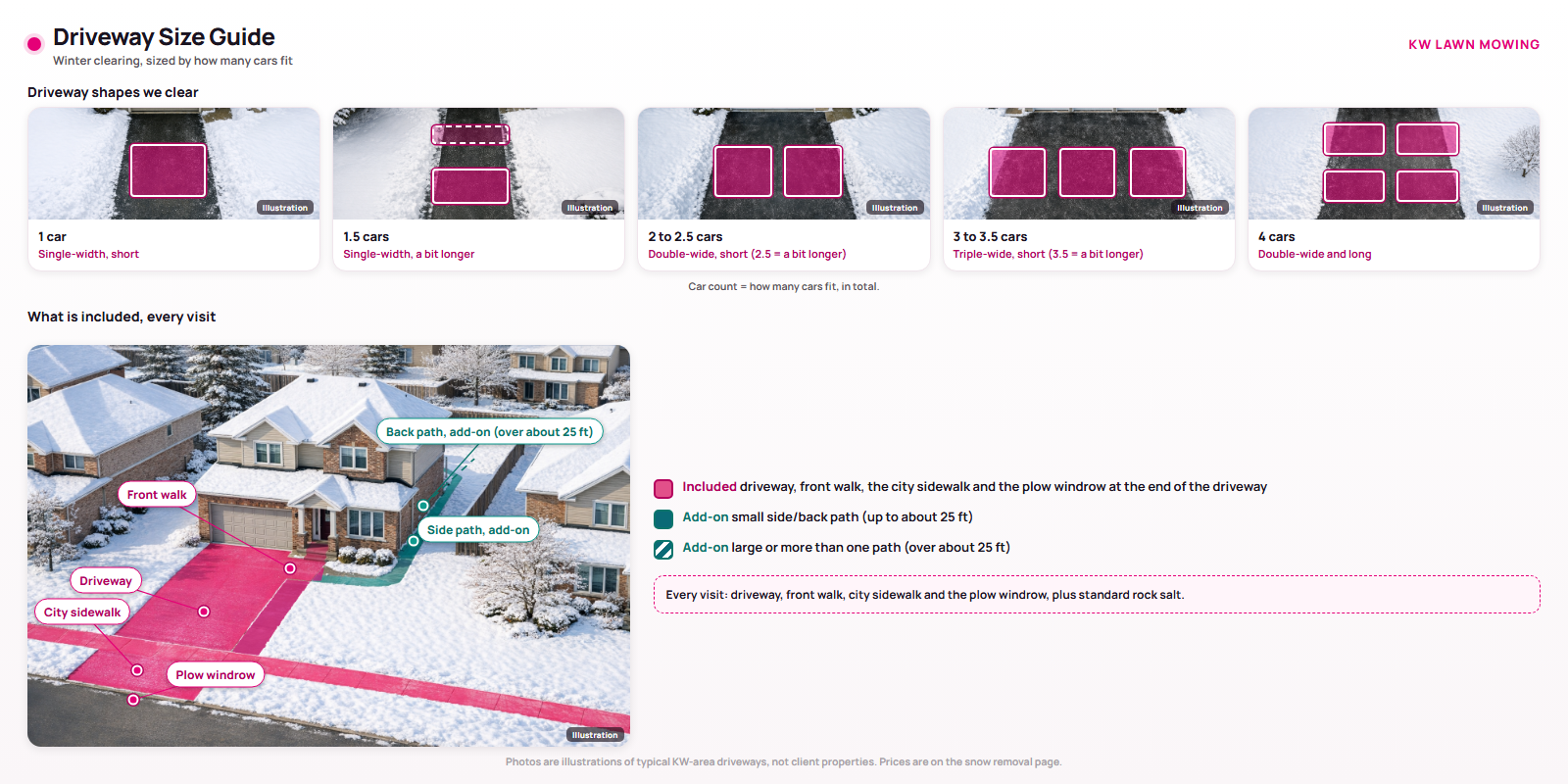
Past 5 cm, the maths change. Snow packs under tires into a ridge you can’t shovel later, the plow ridge at the end of the driveway gets heavy and wet, and the city sidewalk across your frontage gets a lot harder to do by hand. That plow ridge, the windrow left across the end of your driveway, is cleared on every visit we do, per-visit or Winter Plan, at no extra charge.
A 10 cm trigger means the snowfalls in between are yours to shovel. Nobody can tell you how many storms a winter brings, so check your own memory of last winter: how many times did the driveway need doing, and how deep was it. Whatever number a contractor gives you, work out how many days a winter it actually covers. Set it high enough and the contract is mostly decorative.
Note the trigger is about accumulation, not the forecast. A storm that was called for 12 cm and delivered 4 is a no-visit day. A quiet overnight that quietly stacked 7 is a visit day.
What actually happens on a 3 cm day
Honestly? On a 3 cm day, nothing happens at your driveway, and nothing appears on your bill. That’s the deal working correctly, not failing.
The one thing that does change on those days is ice, and this is where the two ways of buying snow clearing differ:
- Per-visit customers pay per clearing, at the trigger. A 3 cm morning isn’t a clearing, so there’s no visit and no charge. If you want salt put down on a sub-trigger day, call us and we’ll price it for your driveway rather than guess at it here.
- Winter Plan customers get unlimited ice control included. Freezing rain, a light dusting that melts and refreezes, a 3 cm morning that turns glassy at dusk, those are covered as part of the plan with no per-event charge.
That’s the real argument for a Winter Plan, and it has nothing to do with big storms. A day that thaws at noon and freezes at four can be slicker than a snow day.
Freezing rain sits outside the trigger entirely
Freezing rain doesn’t accumulate in centimetres, so a snow trigger can’t catch it. It needs its own answer.
Ours is ice control: salt applied to the driveway, front path and city sidewalk. Standard rock salt on the driveway is included in every clearing we do, per visit or season. Two upgrades exist if plain rock salt isn’t right for your property, both $10 per visit and both plus HST:
- Treated salt, which keeps working at colder temperatures and through freezing rain, where plain rock salt starts to give up
- Pet-safe salt, easier on paws, concrete and the garden beds along the edge of the drive
On a Winter Plan, add-ons are quoted with your plan.
If you have a dog, pet-safe is the one to ask for, the same chemical-free instinct behind our organic lawn care the rest of the year. Pink is the new green in July, and still is in January.
The trigger tells you if, the 12 hour clock tells you when
Two different promises, often confused.
The trigger answers if we’re coming. The 12 hours answers when. Once the snow has stopped falling, your driveway is usually cleared within 12 hours. We wait for the system to pass on purpose, because clearing mid-storm means clearing again two hours later and salting twice for nothing.
If a storm runs all night and quits at 9 a.m., the clock starts at 9 a.m. If you need to be out of the driveway sooner than that, faster clearing, within 8 hours, is a per-visit add-on for $15 plus HST. Being first on the route every storm isn’t a per-visit or per-season add-on anymore; that comes bundled into our Winter Priority plan, which puts you first usually within 3 hours. Priority spots are limited each winter, since being first only means something if the list stays short. Full detail is on the Winter plans page.
What this costs, and where the trigger points you
Per-visit clearing runs from $49.99 for a 1 car driveway up to $99.99 for a 4 car driveway, per visit, plus HST. The season option, Winter Plan Standard, unlimited clearings at the same 5 cm trigger from 1 November to 15 April plus unlimited ice control, runs from $712.36 for a 1 car driveway up to $1,424.86 for a 4 car, plus HST.
At every size, the season price is exactly 15 per-visit clearings. So the trigger also settles the per-visit versus season question: expect more than 15 clearable snowfalls and Winter Plan Standard wins, with everything past number 15 free. Full breakdown by driveway size, and the bundled Winter plans, are on the snow removal page, and every price for every service sits on the pricing page.
Questions we get about the trigger
It snowed 4.5 cm. Will you come? No, and you won’t be charged. We hold the line at 5 cm because a trigger that bends on request isn’t a trigger. If borderline snowfalls genuinely bother you, a Winter Plan and its unlimited ice control is the fix.
Who measures it, and can I check? We measure accumulation on the ground, not the forecast. If your street clearly got more, tell us. Our weather and delay terms are in plain words on the policies page.
Does the trigger cover the sidewalk too? Yes. Every clearing includes the full driveway edge to edge, the front path to your door, the city sidewalk across your frontage, and standard rock salt on the driveway. The sidewalk is the part most people forget, so it’s never an extra.
Do I need to call you when it snows? No. Once you’re on the route, the snowfall triggers the visit. You don’t need to be home. It helps if the driveway is clear of cars, but it isn’t required.
Is the trigger the same across Kitchener and Waterloo? Yes, 5 cm everywhere we serve. That’s Kitchener and Waterloo, with Mannheim at the edge of the map. We don’t service Cambridge. Boundaries and postal prefixes are on the service area page.
Getting on the route
Tell us your address and driveway size and we’ll send back a fixed price, no site visit needed for most driveways. Call or text 226-336-2077, or use the contact page.
More on how we clear and what’s included: snow removal, or the city pages for Kitchener and Waterloo. Other questions live on the FAQ.